


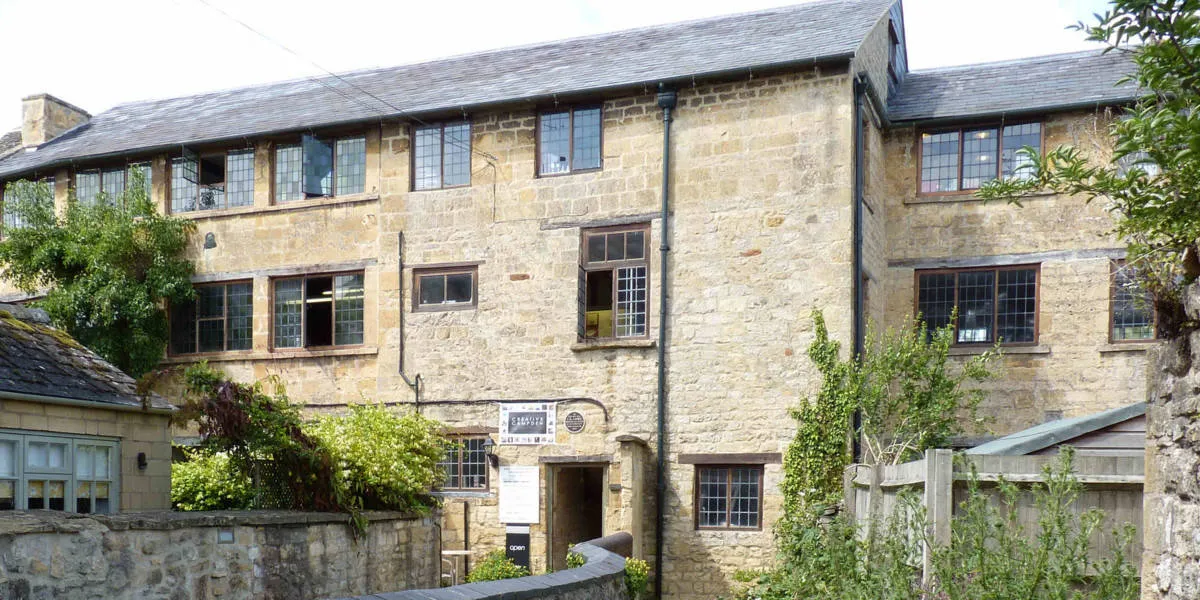
Chipping Campden has important links with the Arts and Crafts movement. In 1902 the architect and designer Charles Robert Ashbee moved his Guild of Handicraft into the Old Silk Mill on Sheep Street, and the town has been a centre for fine craftsmanship ever since.
Key takeaways
- In 1902 C.R. Ashbee moved his Guild of Handicraft from London's East End to the Old Silk Mill on Sheep Street.
- Around 100 craftsmen and their families made the move in search of a healthier, simpler country life.
- The Guild specialised in metalwork, producing jewellery, enamels, hand wrought copper, wrought ironwork and furniture.
- Hart Silversmiths, the last family business from those days, still works in the mill in its original surroundings.
- The Old Silk Mill is just off the High Street, and fine Guild work can be seen at Court Barn Museum.
From the East End to Chipping Campden
Early in the 20th century Chipping Campden became known as a centre of the Cotswold Arts and Crafts movement, after C.R. Ashbee brought the members of his Guild and School of Handicraft from the East End of London in 1902. Around 100 craftsmen and their families made the move, in search of a healthier and simpler life in the country.
What the Guild made
The Guild of Handicraft specialised in metalwork. Its craftsmen produced:
- Jewellery and enamels
- Hand wrought copper
- Wrought ironwork
- Furniture
You can see fine examples of Guild work at Court Barn Museum, which tells the story of craft and design in the north Cotswolds.
Artists and writers who followed
A number of artists and writers settled in the area in the Guild's wake. F.L. Griggs, the etcher, built Dover's House, one of the last significant Arts and Crafts houses, and with Norman Jewson and others set up the Campden Trust, at first to protect Dover's Hill from development. H.J. Massingham, the rural writer who celebrated the traditions of the English countryside, also settled near the town. Read more in our guide to Arts and Crafts in Chipping Campden.
The Old Silk Mill today
The Old Silk Mill still carries on the Guild's tradition. It is home to the last family business from those days, Hart Silversmiths, where you can see silversmiths working in the original surroundings. You can find Hart Silversmiths in our directory. The mill also houses the Gallery at the Guild, a jeweller and a coffee shop, and in 1955 the designer Robert Welch set up his studio here too.
Visiting the Guild of Handicraft
The Old Silk Mill is on Sheep Street, just off the High Street, and is an easy walk from anywhere in the town. It is a good stop on any tour of shopping in Chipping Campden. For parking, see our parking guide.